
The Question
Walk into a mall in Pune, a quick-commerce dark store in Bengaluru, or a rural haat in Uttar Pradesh, and you'll see three very different versions of the same economy. One buys iPhones on EMI. One orders groceries that arrive in ten minutes. One is still deciding whether to upgrade from a feature phone.
India's GDP headlines tell a single story: one of the fastest-growing large economies in the world, with real GDP growth of 8.2% in FY 2023-24, the highest in the previous twelve years outside the post-pandemic rebound year (MoSPI, National Accounts data). But growth numbers hide a more interesting question underneath them — who is actually driving that growth, and can they keep driving it?
For decades, the working assumption was that India grows through investment and exports, the way East Asian economies did. But India's growth engine has always looked different. Private consumption (PFCE) is not a side character in the Indian growth story — it stood at 60.2% of GDP in FY 2023-24 at current prices, among the highest shares of any major economy (MoSPI, Second Advance Estimates commentary). If India's growth engine has a driver's seat, the Indian consumer is sitting in it.
This article asks a simple question with a complicated answer: is India's middle class large enough, rich enough, and confident enough to carry the economy through its next growth phase?
Background: India’s Consumption Story
India's consumption story is inseparable from three underlying shifts that have played out since liberalisation in 1991: population growth, income growth, and urbanisation.
Population. India overtook China in 2023 to become the world's most populous country, at roughly 1.44 billion people (UN Population Fund, 2023 estimate). The more important number isn't the total — it's the median age, around 28. A young population consumes differently than an ageing one: more discretionary spending, more borrowing against future income, more appetite for new categories of goods and services.
Income growth. Per capita income has risen substantially since 1991, though from a low base. What matters for consumption isn't just the average — it's the shape of the income distribution. India has a large mass of the population moving from subsistence spending toward "just above subsistence" spending, and a smaller but fast-growing group moving into genuinely discretionary spending.
Urbanisation. Roughly a third of Indians live in urban areas today, a share that has been rising steadily. Urban living changes consumption patterns almost mechanically — different food habits, different transport needs, higher exposure to organised retail, more women in the workforce, and greater access to credit and digital payment rails.
Who Is India’s Middle Class?
"Middle class" is one of the most misused terms in Indian economic commentary, so it's worth being precise. There is no single official definition. Economists have used different income bands — some define India's middle class as households earning roughly ₹5 lakh to ₹30 lakh a year, others use consumption-based thresholds, others use asset ownership (car, air conditioner, smartphone) as a proxy. Estimates of the size of this group vary widely.
What matters more than the exact headcount is the direction of travel. A large number of Indian households are crossing from "necessity spending" — where nearly all income goes to food, basic clothing, and shelter — into "discretionary spending," where a meaningful share of income is left over after essentials. This is the group that matters most for the consumption story, because it is the group whose spending decisions are elastic.
Income vs. consumption. Some Indian households consume more than their reported income would suggest, financed through credit — a trend that has accelerated with the growth of consumer lending and "buy now, pay later" products. This means consumption growth can, for a period, outrun income growth, and consumption growth built on credit is more fragile than consumption growth built on income.
From Necessities to Discretionary Spending
The clearest way to see India's consumption shift is category by category. Food: as incomes rise, the share of spending on food falls (Engel's Law), but the composition shifts toward processed foods, packaged snacks, dairy, and eating out. Smartphones: penetration has moved from luxury to near-necessity across income groups, driven by falling handset prices and cheap mobile data. Cars: passenger vehicle sales, particularly SUVs, show that a meaningful slice of households now have room for large discretionary purchases, often on auto loans. Travel: domestic air travel and tourism have grown sharply as flying stopped being an elite activity. Financial products: mutual fund SIPs, insurance, and retail stock market participation have all expanded. Entertainment: streaming and out-of-home entertainment have grown as discretionary income has found new places to go.
Urban vs. Rural India
It would be a mistake to treat "the Indian consumer" as one person. Urban India has higher per-capita spending, more exposure to organised retail and e-commerce, and faster adoption of new categories. Rural India — still home to the majority of Indians — has historically lagged on discretionary spending, but rural consumption has periodically surged when the monsoon has been good or crop prices favourable. This means rural consumption is more volatile and more tied to agricultural income than urban consumption, which is increasingly tied to wages, salaries, and urban services employment.
The Rise of Digital Consumption
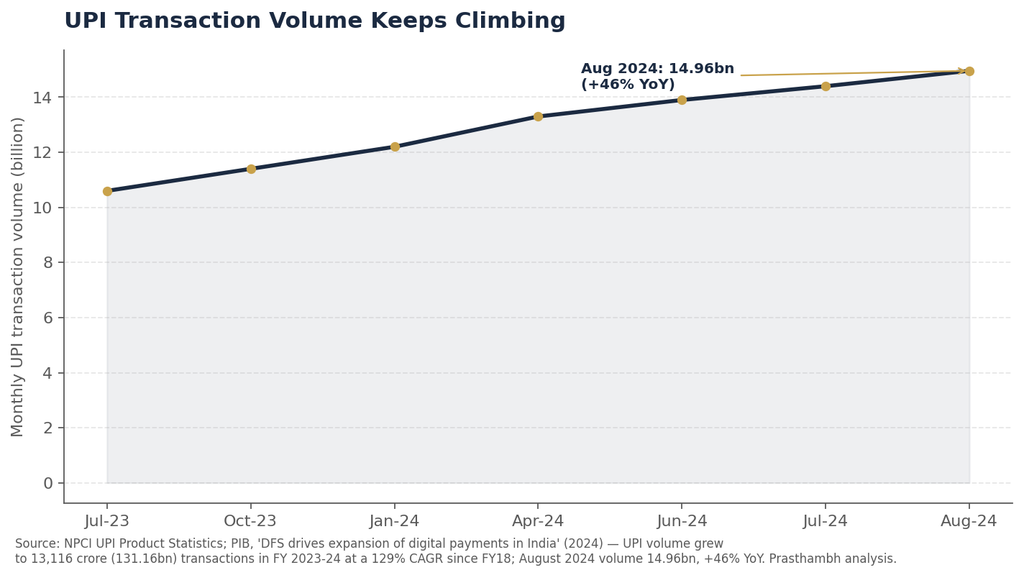
Source: NPCI UPI Product Statistics; PIB, 'DFS drives expansion of digital payments in India' (2024) — UPI volume grew to 13,116 crore (131.16bn) transactions in FY 2023-24 at a 129% CAGR since FY18; August 2024 volume 14.96bn, +46% YoY. Prasthambh analysis.
What this chart tells us — and doesn’t
It tells us India's shift to digital payments has been genuinely explosive, not gradual — UPI volume grew at a 129% compound annual growth rate between FY18 and FY24, and monthly volume kept climbing through 2024, hitting 14.96 billion transactions in August alone, up 46% year-on-year (NPCI; PIB). It does not tell us how much of this reflects genuinely new spending versus simply the same spending shifting from cash to digital rails — a meaningful share of UPI's growth is migration of existing transactions, not new consumption being created.
E-commerce has expanded well beyond the big metros into tier-2 and tier-3 towns, aided by falling data costs and vernacular-language interfaces. Quick commerce — grocery and essentials delivered within 10-20 minutes — is arguably the most India-specific consumption innovation of the last few years, built on dense urban populations, cheap labour, and the UPI payment rail.
The Business Opportunity
For businesses, India's consumption shift has created genuine opportunities: FMCG premiumisation (consumers trading up from unbranded to branded, higher-margin products); SUVs and premium two-wheelers capturing disproportionate growth in autos; insurance, mutual funds, and consumer lending benefiting from rising formal financial participation; domestic tourism and budget-to-mid-market hotel chains expanding; and consumer durables moving from luxury to expected household items in urbanising areas.
The Problem
Inequality. Consumption growth has been uneven. A relatively narrow band of urban, higher-income households accounts for a disproportionate share of discretionary spending growth, visible in the divergence between "premium" and "mass" segments across FMCG and autos in recent quarters.
Employment. Consumption ultimately depends on income, and income depends on jobs. India's employment growth, particularly in well-paying formal-sector jobs, has not kept pace with the number of people entering the workforce each year.
Household debt. Some of India's recent consumption growth has been financed by borrowing rather than income growth. Retail credit — personal loans, credit cards, consumer durable loans — has grown quickly, and this makes consumption growth financed this way sensitive to interest rates and to any deterioration in household repayment capacity.
Prasthambh Perspective
India's consumption story is real, but consumption alone cannot sustain high growth indefinitely. UPI's 46% year-on-year volume growth this August is a genuinely impressive number, but it measures the plumbing of spending, not necessarily its underlying health. The next phase depends on whether rising consumption is accompanied by productivity, employment and private investment — not just easier access to credit and faster payment rails.
Sources & Further Reading
- MoSPI — Second Advance Estimates of Annual GDP for 2024-25 (PIB, 2025 release, containing FY23-24 final estimates): PFCE at 60.2% of GDP (current prices) in FY 2023-24, vs 61.5% in FY 2022-23
- MoSPI/PIB — FY 2023-24 real GDP growth of 9.2%, revised (First Revised Estimates)
- NPCI — UPI Product Statistics, monthly volume/value series
- PIB — 'DFS drives expansion of digital payments in India and abroad' (2024): UPI transaction volume grew to 13,116 crore in FY 2023-24 from 92 crore in FY 2017-18, a 129% CAGR
- UN Population Fund — State of World Population 2023: India population ~1.44 billion, overtaking China
- World Bank — Final consumption expenditure (% of GDP), India, historical series